Arizona's Vision Eye Care Center

VisionWorks vs. America's Best at a Glance
Before diving into the details, it helps to understand what each company is and how they position themselves in the optical retail market. Both operate nationally, both have multiple Phoenix-area locations, and both promise affordable eye care. But their business models differ in ways that affect your wallet and your experience.What Is VisionWorks?
VisionWorks is a national optical retail chain owned by Essilor Luxottica, the same parent company behind LensCrafters, Ray-Ban, and Oakley. It operates over 700 locations across the United States, including several stores in the Phoenix metropolitan area. VisionWorks positions itself as a mid-range option, offering brand-name frames, in-store eye exams conducted by independent optometrists or employed doctors, and a range of lens packages. The chain accepts most major vision insurance plans and frequently runs promotional pricing on frames and lenses.What Is America's Best?
America's Best Contacts & Eyeglasses is a budget-focused optical chain owned by National Vision Holdings, which also operates Eyeglass World and Vista Optical locations inside Walmart. America's Best is known for its signature bundle deal: two pairs of glasses plus a free eye exam starting at a low advertised price. The chain has more than 900 U.S. locations, with multiple stores serving Phoenix and surrounding communities. Its model targets cost-conscious shoppers who want basic eye care and eyewear without insurance.Side-by-Side Comparison Table
| Feature | VisionWorks | America's Best |
| Parent Company | Essilor Luxottica | National Vision Holdings |
| U.S. Locations | 700+ | 900+ |
| Phoenix-Area Stores | Multiple | Multiple |
| Starting Exam Price | ~$79–$99 (without insurance) | Free with 2-pair bundle (~$69.95+) |
| Frame Brands | Designer and house brands (Ray-Ban, Coach, Nike) | Primarily house brands, limited designer |
| Lens Options | Standard to premium (Varilux, Crizal, Transitions) | Standard to mid-tier |
| Contact Lens Selection | Broad (major brands) | Broad (major brands) |
| Insurance Accepted | VSP, EyeMed, most major plans | EyeMed, select plans; designed for uninsured |
| Exam Provider | Independent or employed ODs | Employed or affiliated ODs |
| Turnaround Time | Varies; some same-day | Varies; some same-day |
Eye Exam Quality and Provider Credentials
An eye exam is the foundation of every visit to an optical store. The quality of that exam determines whether your prescription is accurate, whether early signs of eye disease get caught, and whether you leave with the right guidance for your vision needs. Not all eye exams are equal, even when they happen in stores that look similar from the outside.Who Performs Your Eye Exam at Each Store?
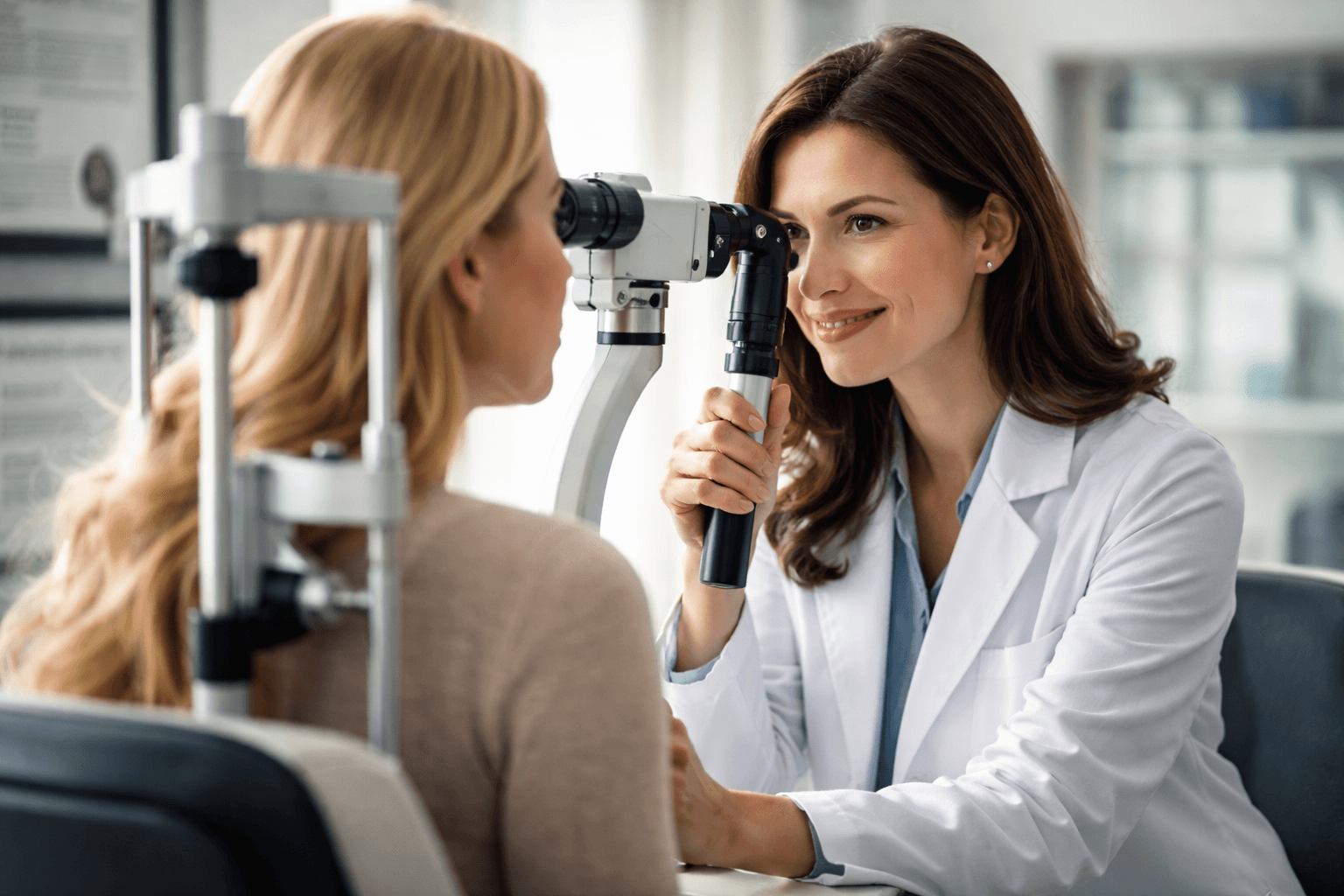
At both VisionWorks and America's Best, your eye exam is performed by a licensed optometrist (OD). These are doctors who completed four years of optometry school after undergraduate education and hold state licensure in Arizona. Some VisionWorks locations employ their optometrists directly, while others lease space to independent practitioners. America's Best typically uses optometrists employed through its affiliated medical group. The credentials are comparable on paper. The practical difference often comes down to the individual doctor, how much time they spend with each patient, and whether the store's scheduling model allows for thorough examinations or pushes for volume.What Does a Comprehensive Eye Exam Include?
A standard comprehensive eye exam should include visual acuity testing, refraction to determine your prescription, eye muscle function assessment, pupil response evaluation, slit-lamp examination of the front structures of the eye, and a dilated or non-dilated evaluation of the retina and optic nerve. The American Optometric Association recommends comprehensive eye exams at regular intervals based on age and risk factors. Both chains advertise comprehensive exams. However, the depth of each component can vary based on time constraints, available diagnostic equipment, and the clinical priorities of the examining doctor.How Thorough Are the Exams at Each Chain?
Patient reviews and industry observations suggest a range of experiences at both retailers. VisionWorks locations, backed by Essilor Luxottica's resources, sometimes offer more advanced diagnostic technology such as retinal imaging. America's Best, with its high-volume, low-cost model, may allocate less time per patient in some locations. Neither chain is designed to function as a medical eye care practice. If your exam reveals signs of glaucoma, macular degeneration, diabetic retinopathy, or another medical condition, the in-store optometrist will typically refer you to an ophthalmologist or a comprehensive optometric practice equipped for ongoing medical management. The exam gets you started. It does not always get you finished.Pricing, Insurance, and Value
Cost is often the deciding factor when people choose between VisionWorks and America's Best. Both chains compete aggressively on price, but their pricing structures work differently. Understanding those differences helps you avoid surprises at checkout.Eye Exam Costs at VisionWorks vs. America's Best
America's Best leads on upfront exam pricing. Its signature offer bundles a free eye exam with the purchase of two pairs of glasses starting around $69.95. For patients without vision insurance, this deal is hard to beat on price alone. A standalone exam at America's Best typically costs around $50 to $75. VisionWorks eye exams generally range from $79 to $99 without insurance, though promotional pricing can bring that down. With vision insurance like VSP or EyeMed, copays at VisionWorks often fall between $10 and $25 depending on your plan.Glasses and Contact Lens Pricing
America's Best keeps base pricing low. The two-pair bundle starts under $70, but those base frames are house-brand styles with basic single-vision lenses. Upgrading to progressive lenses, anti-reflective coatings, or photochromic lenses adds cost quickly. A final bill of $200 to $350 after upgrades is common. VisionWorks frames start higher, typically $100 to $300 for designer options, but the chain runs frequent promotions such as buy-one-get-one deals or percentage discounts. Lens packages at VisionWorks include access to premium Essilor lens technology like Varilux progressives and Crizal anti-reflective coatings. Contact lens pricing at both chains is competitive with online retailers for major brands like Acuvue, Air Optix, and Biofinity.Insurance Acceptance and Discount Plans
VisionWorks accepts a wider range of vision insurance plans, including VSP, EyeMed, MetLife, Davis Vision, and many employer-sponsored plans. This makes VisionWorks the more practical choice if you carry vision benefits. America's Best accepts EyeMed and some other plans but markets itself primarily to patients paying out of pocket. Its in-house discount club, the Eyecare Club, offers two years of eye exams and discounts on glasses and contacts for a flat membership fee. For uninsured patients or those with high-deductible plans, this membership can deliver real savings. The bottom line on value: America's Best wins on sticker price for basic eyewear without insurance. VisionWorks often delivers better value when you factor in insurance benefits, lens quality, and frame selection.Frame Selection, Lens Options, and Brands
Eyeglasses are something you wear on your face every day. The frames you choose affect your comfort, your appearance, and how long your glasses last. Lens quality affects how clearly you see and how well your eyes are protected. Both matter.Frame Variety and Designer Brands
VisionWorks carries a significantly broader selection of designer and brand-name frames. Because its parent company Essilor Luxottica owns or licenses brands like Ray-Ban, Oakley, Coach, Versace, Prada, Nike Vision, and Armani Exchange, VisionWorks stores stock these labels alongside more affordable house brands. If frame style and brand recognition matter to you, VisionWorks has a clear advantage. America's Best focuses on affordability. Its frame wall features mostly proprietary and budget-friendly brands. You will find functional, decent-looking options, but the selection skews toward basic styles. Some locations carry a small number of recognizable names, but the variety does not compare to VisionWorks or independent optical shops.Lens Upgrades and Add-Ons
Lens technology is where VisionWorks benefits most from its Essilor Luxottica connection. The chain offers Essilor-manufactured lenses including Varilux progressive lenses, Crizal anti-reflective and scratch-resistant coatings, and Transitions adaptive lenses. These are widely regarded as premium products in the optical industry. America's Best offers standard and mid-tier lens options. You can get progressive lenses, basic anti-reflective coatings, and blue-light filtering add-ons. The quality is adequate for many patients, but the lens technology does not match the top-tier Essilor products available at VisionWorks.Contact Lens Availability
Both chains sell contact lenses from major manufacturers including Johnson & Johnson (Acuvue), Alcon (Air Optix, Dailies), and CooperVision (Biofinity, clariti). Pricing is competitive at both, and both offer online reordering. Contact lens fittings are available at each chain as part of or in addition to the standard eye exam. For straightforward contact lens needs, there is no significant difference between the two retailers. Specialty lenses for astigmatism, multifocal needs, or hard-to-fit eyes may require a more specialized fitting than either chain routinely provides.Customer Experience and Convenience
How a visit feels matters almost as much as what it costs. Wait times, staff attentiveness, store environment, and scheduling ease all shape whether you leave satisfied or frustrated.Appointment Scheduling and Wait Times
Both VisionWorks and America's Best offer online appointment booking through their websites and apps. Walk-ins are accepted at most locations but may involve longer waits, especially on weekends. America's Best locations tend to experience higher patient volume due to the low-cost model, which can mean longer wait times and a more crowded store environment. VisionWorks locations generally report moderate wait times, though experiences vary by store and time of day.Phoenix Store Locations and Hours
Both chains maintain multiple locations across the Phoenix metro area, including stores in Tempe, Mesa, Chandler, Glendale, Scottsdale, and Peoria. Most locations operate Monday through Saturday with reduced Sunday hours. America's Best stores are frequently located in strip malls and shopping centers with easy parking access. VisionWorks locations appear in similar retail settings and occasionally in larger shopping malls. Neither chain has a significant location advantage in the Phoenix market. Proximity to your home or workplace will likely be the deciding factor.Customer Reviews and Satisfaction Trends
Online reviews for both chains are mixed, which is typical for high-volume retail optical. Common praise for America's Best centers on affordability and the two-pair deal. Common complaints mention rushed exams, long waits, and limited frame quality. VisionWorks reviews frequently highlight better frame selection and a more comfortable store experience, with complaints about upselling on lens packages and occasional insurance billing issues. Neither chain consistently earns the kind of patient satisfaction ratings associated with independent optometry practices, where longer appointment times and personalized attention are standard.Limitations of Retail Optical Chains for Eye Health
Comparing VisionWorks and America's Best on price and product is useful. But the more important question for many patients is whether either chain can fully meet their eye care needs. For routine prescriptions and basic eyewear, both can work. For anything beyond that, the limitations become real.When a Retail Eye Exam Is Not Enough
A retail eye exam is designed primarily to determine your glasses or contact lens prescription. It includes a basic health screening, but it is not a substitute for a medical eye examination. If you are experiencing flashes, floaters, sudden vision changes, eye pain, redness that does not resolve, or double vision, a retail optical store is not the right first stop. These symptoms may indicate conditions like retinal detachment, acute glaucoma, uveitis, or optic nerve problems that require urgent evaluation with specialized diagnostic equipment and clinical expertise that retail settings do not typically have.Medical Eye Conditions That Need More Than a Chain Store
Chronic eye conditions such as glaucoma, macular degeneration, diabetic eye disease, dry eye syndrome, and keratoconus require ongoing monitoring, medical treatment, and sometimes surgical referral. Retail chain optometrists can detect signs of these conditions during a routine exam, but managing them requires a practice equipped with advanced imaging technology like OCT (optical coherence tomography), visual field testing, and the clinical infrastructure for follow-up care. The National Eye Institute estimates that more than 3 million Americans have glaucoma, and many do not know it because the disease progresses without obvious symptoms in its early stages. Catching it during a retail exam is possible. Managing it there is not.Why Continuity of Care Matters for Your Vision
When you see a different optometrist at a chain store every visit, there is no continuity. No one doctor tracks your prescription changes over time, monitors subtle shifts in your eye health, or knows your medical history well enough to catch patterns. Continuity of care is a clinical advantage that independent practices and dedicated eye care centers provide by design. For children, older adults, patients with diabetes, and anyone with a family history of eye disease, this continuity is not a luxury. It is a safeguard.How to Choose the Right Eye Care Provider in Phoenix
If you have read this far, you understand that the VisionWorks vs. America's Best question is really a starting point. The deeper question is what kind of eye care you actually need and which provider can deliver it.Questions to Ask Before Booking an Eye Exam
Before scheduling at any optical retailer or eye care office, consider these questions:- Do I just need a prescription update, or am I experiencing symptoms that concern me?
- Do I have a chronic health condition like diabetes or high blood pressure that affects my eyes?
- Has it been more than two years since my last comprehensive eye exam?
- Do I have a family history of glaucoma, macular degeneration, or other eye diseases?
- Am I looking for a one-time transaction or an ongoing relationship with an eye care provider?
When to See an Independent Optometrist Instead
An independent optometrist or a comprehensive eye care center is the better choice when you need medical eye care, not just a prescription. Independent practices typically offer longer appointment times, advanced diagnostic technology, continuity with the same doctor, and the ability to diagnose, treat, and manage eye diseases rather than simply refer you elsewhere. For families with children who need pediatric vision assessments, for adults over 40 entering the age range where glaucoma and macular degeneration risk increases, and for anyone managing a systemic health condition that affects the eyes, independent eye care delivers a level of service that retail chains are not built to match.What Arizona's Vision Eye Care Center Offers Beyond Retail
Arizona's Vision Eye Care Center in Phoenix provides the kind of comprehensive, patient-focused eye care that fills the gaps retail chains leave open. Our optometrists perform thorough medical eye examinations using advanced diagnostic technology, spend the time needed to evaluate each patient's full visual and ocular health picture, and build long-term care relationships that allow us to track changes and catch problems early. We handle everything from routine eye exams and contact lens fittings to diagnosis and management of conditions like glaucoma, dry eye, diabetic retinopathy, and macular degeneration. When ophthalmology referral or surgical consultation is needed, we coordinate that care directly so patients never feel lost in the system. We also offer a wide selection of quality eyewear, competitive pricing, and insurance-friendly billing. You get the convenience and affordability you expect, plus the clinical depth and personal attention that a retail chain cannot provide.Conclusion
VisionWorks and America's Best each serve a purpose. America's Best offers the lowest entry price for basic eyewear. VisionWorks provides better frame selection and lens technology. But neither chain replaces the clinical depth, continuity, and personalized attention of a dedicated eye care practice. Your eyes deserve more than a transaction. They deserve a provider who knows your history, monitors your health over time, and guides you to the right care at every stage of life. We invite you to experience the difference at Arizona's Vision Eye Care Center. Schedule your comprehensive eye exam today and see what patient-focused eye care in Phoenix truly looks like.Frequently Asked Questions
Is America's Best really cheaper than VisionWorks?
For basic eyewear without insurance, yes. America's Best two-pair bundle with a free exam starts around $69.95, which undercuts VisionWorks' standard pricing. However, once you add lens upgrades like progressives or anti-reflective coatings, the price gap narrows significantly.Do VisionWorks and America's Best accept VSP or EyeMed insurance?
VisionWorks accepts both VSP and EyeMed along with most major vision plans. America's Best accepts EyeMed and select other plans but is primarily designed for patients paying out of pocket or using its in-house Eyecare Club membership.Are the eye doctors at VisionWorks and America's Best licensed optometrists?
Yes. Both chains use licensed optometrists (ODs) who have completed accredited optometry programs and hold valid Arizona state licensure. The quality of your exam depends on the individual doctor and how much time the store's scheduling model allows per patient.Can VisionWorks or America's Best diagnose and treat eye diseases?
The optometrists at both chains can detect signs of eye disease during a routine exam. However, neither chain is set up for ongoing medical eye care management. Conditions like glaucoma, macular degeneration, or diabetic eye disease typically require referral to a medical eye care practice or ophthalmologist.Which chain has better frame selection in Phoenix?
VisionWorks offers a wider range of designer and brand-name frames, including Ray-Ban, Coach, Oakley, and Nike Vision, thanks to its Essilor Luxottica ownership. America's Best focuses on budget-friendly house brands with limited designer options.How long does an eye exam take at VisionWorks vs. America's Best?
Most exams at either chain take 20 to 30 minutes. America's Best locations with higher patient volume may feel more rushed. VisionWorks appointments can vary but generally allow a moderate pace. Neither chain matches the 45- to 60-minute comprehensive exams typical at independent practices.Should I go to an independent eye doctor instead of a retail chain?
If you need more than a basic prescription update, yes. Independent eye care providers offer longer exams, advanced diagnostics, continuity of care, and the ability to manage medical eye conditions. For patients with diabetes, glaucoma risk, children's vision needs, or any eye health concerns, an independent practice like Arizona's Vision Eye Care Center provides a higher standard of care.
Dr. Page is a licensed Doctor of Optometry, and a long time resident of Ahwatukee Arizona. He graduated from the New England College of Optometry in Boston in 1990. He moved to Phoenix to serve the community in both his clinic and by becoming a community activist.
He is deeply involved in supporting the local athletic teams, the arts, pet adoption and children. He is a charter member of the Chamber of Commerce.
After watching his father lose vision in his right eye he dedicated his career to finding a way to stopping eyes from getting worse. He is the founder of the Invisalens eye retainer and a best selling author for his book: Freedom! The Smart Parents Guide to Helping Your Child See a Better Life.
He specializes in helping his patients see better with eyeglasses, contact lenses, nutrition and genetics.
Words can't describe what our eyes bring to life!