Arizona's Vision Eye Care Center

A standard eye exam at Target Optical typically costs between $55 and $90 without insurance, depending on your location and the type of exam you need. That price point makes Target a popular choice for routine vision checks, but it does not always tell the full story about what your eyes actually require.
This guide breaks down Target Optical's exam pricing, what each exam includes, insurance acceptance, and how retail eye exams compare to comprehensive care from a dedicated eye care provider. Whether you are scheduling a quick prescription update or wondering if your symptoms call for something more thorough, you will find clear answers here.
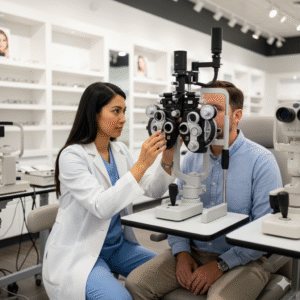
What Does a Target Optical Eye Exam Cost?
Target Optical locations house independent optometrists who set their own fees. Prices vary by region, but most patients in the Phoenix, AZ area can expect costs within a predictable range. Understanding the difference between a basic vision exam and a contact lens fitting helps you budget accurately before you book.
Standard Comprehensive Eye Exam Pricing
A routine comprehensive eye exam at Target Optical generally falls between $55 and $90 for patients paying out of pocket. This exam covers visual acuity testing, refraction to determine your glasses prescription, and a basic evaluation of eye health. Prices in Phoenix tend to sit near the middle of that range, though the specific optometrist practicing inside your local Target store determines the final fee.
It is worth noting that “comprehensive” at a retail optical center does not always mean the same thing as a comprehensive medical eye exam at a dedicated eye care practice. The retail version focuses primarily on determining your corrective lens prescription and performing a screening-level check of your eye health.
Contact Lens Exam and Fitting Fees
If you wear contact lenses or want to start, expect to pay an additional $50 to $100 on top of the standard exam fee. A contact lens exam includes extra measurements of your corneal curvature, tear film evaluation, and a fitting assessment to determine the best lens type and brand for your eyes.
The total cost for a contact lens exam at Target Optical, including the comprehensive portion, typically ranges from $105 to $190 without insurance. Follow-up visits to check lens fit may or may not be included in that initial fee, so ask before your appointment.
Additional Testing and Specialty Exam Costs
Some patients need retinal imaging, visual field testing, or dilation during their exam. Retinal photography, sometimes marketed as an “optomap” or digital retinal scan, usually costs an extra $25 to $40 at Target Optical. Dilation is often included at no additional charge, but not every provider performs it as part of a standard visit.
If the optometrist identifies a concern that requires further evaluation, such as elevated eye pressure or an unusual finding on the retina, they will typically refer you to an ophthalmologist or a full-service eye care center for follow-up. That referral means a separate appointment and potentially different costs depending on your insurance and the complexity of the issue.
What Is Included in a Target Optical Eye Exam?
Knowing what you are paying for helps you decide whether a Target eye exam meets your needs or whether you should seek a more thorough evaluation elsewhere. The scope of a retail eye exam is designed for healthy patients who primarily need a prescription update.
Vision Acuity and Refraction Testing
Every eye exam at Target Optical begins with a visual acuity test, the familiar letter chart that measures how clearly you see at various distances. The optometrist then performs refraction, using a phoropter or trial lenses to fine-tune your prescription for glasses or contacts.
This portion of the exam answers the most common question patients have: “Do I need glasses, and if so, what strength?” For many people with stable vision and no underlying eye conditions, this is the primary reason for the visit.
Eye Health Screening and Dilation
The optometrist will also perform a basic screening of your eye health. This typically includes checking your eye pressure with a tonometer, examining the front structures of your eye with a slit lamp, and evaluating your pupils' response to light.
Dilation, which involves placing drops in your eyes to widen the pupil for a better view of the retina and optic nerve, may be offered but is not always performed at every visit. If you have risk factors for conditions like glaucoma, diabetic retinopathy, or macular degeneration, dilation is an important part of a thorough exam. Ask your provider whether it will be included.
Prescription Updates for Glasses and Contacts
At the end of your exam, you will receive an updated prescription for eyeglasses. If you had a contact lens fitting, you will also receive a contact lens prescription, which is a separate document with additional specifications like base curve and diameter.
Federal law requires your provider to give you a copy of your prescription at no extra charge, regardless of whether you purchase eyewear from Target Optical. You are free to fill your prescription anywhere you choose.
Does Insurance Cover an Eye Exam at Target?
Insurance coverage can significantly reduce your out-of-pocket cost for an eye exam at Target Optical. However, the type of insurance you carry matters. Vision insurance and medical insurance work differently when it comes to eye care.
Vision Insurance Plans Accepted at Target Optical
Most Target Optical locations accept major vision insurance plans. Coverage typically reduces your exam copay to $10 to $25 for a routine vision exam, depending on your specific plan. Some plans also provide allowances toward eyeglass frames and lenses purchased at the same location.
Check with your local Target Optical to confirm which plans they accept before scheduling. Accepted plans can vary by location because the optometrists practicing inside Target stores operate as independent providers.
Using VSP, EyeMed, or Medicare at Target
VSP and EyeMed are two of the most common vision insurance carriers in the United States, and both are widely accepted at Target Optical locations. If you have either plan, your routine eye exam is likely covered with a small copay.
Medicare Part B covers eye exams only when they are medically necessary, such as for monitoring diabetic eye disease or evaluating a specific symptom. Medicare does not cover routine vision exams for glasses prescriptions. If you need a medical eye exam, a dedicated eye care provider or ophthalmologist's office may be a more appropriate setting than a retail optical center.
Out-of-Pocket Costs Without Insurance
Without insurance, you will pay the full exam fee, which ranges from $55 to $90 for a standard exam and $105 to $190 for a contact lens exam. Some Target Optical locations offer periodic promotions that can lower these costs, but discounts are not guaranteed.
If cost is a concern and you do not have vision insurance, compare pricing between Target Optical, Walmart Vision Center, Costco Optical, and independent eye care practices in Phoenix. The lowest sticker price does not always represent the best value, especially if your eyes need more than a basic prescription check.
How to Save Money on an Eye Exam at Target
Several strategies can help reduce the cost of your eye exam at Target Optical, whether you have insurance or not.
Target Optical Promotions and Coupons
Target Optical periodically runs promotions that bundle an eye exam with a discount on eyeglass frames or lenses. These offers change seasonally and are often advertised on the Target Optical website or through the Target Circle rewards program.
Signing up for Target Circle is free and occasionally unlocks exclusive discounts on optical services. Check the app or website before your appointment to see if any current offers apply.
Bundling Exams with Glasses or Contact Purchases
Purchasing your eyewear at the same location where you get your exam can sometimes unlock package pricing. Target Optical may offer a reduced exam fee or a percentage off frames when you buy both together.
That said, always compare the total cost of the bundle against purchasing your exam at Target and ordering glasses from an online retailer. Online eyewear companies like Zenni Optical or Warby Parker often sell frames and lenses at significantly lower prices than brick-and-mortar stores.
Comparing Target Eye Exam Costs to Other Retailers
Target Optical's pricing is competitive with other retail optical chains. For context, here is how exam costs generally compare across major retailers in the Phoenix area:
| Retailer | Standard Eye Exam (No Insurance) | Contact Lens Exam (No Insurance) |
| Target Optical | $55 – $90 | $105 – $190 |
| Walmart Vision Center | $50 – $80 | $100 – $175 |
| Costco Optical | $60 – $100 | $120 – $185 |
| LensCrafters | $75 – $110 | $130 – $200 |
| Independent Optometrist | $75 – $150 | $125 – $225 |
Prices are approximate and vary by location and provider. Independent optometrists often charge more per exam but may include services, like dilation or retinal imaging, that retail locations charge separately for.
Target Optical Eye Exam vs. Independent Eye Care Providers
A Target eye exam works well for straightforward prescription updates. But not every patient's needs are straightforward. Understanding the difference between a retail optical exam and a visit to a full-service eye care provider helps you make the right choice for your situation.
Scope of Care at Retail Optical Centers
Retail optical centers like Target Optical are designed for efficiency. The independent optometrists who practice there focus primarily on refractive care, meaning they determine your prescription for glasses or contacts and perform a basic eye health screening.
If everything looks normal, you leave with a prescription and the option to shop for eyewear on-site. This model works well for healthy adults and children who have no symptoms, no history of eye disease, and no systemic health conditions that affect the eyes.
When a Comprehensive Eye Care Provider Is a Better Fit
If you are experiencing eye pain, sudden vision changes, flashes of light, floaters, redness, or persistent dryness, a retail eye exam may not be sufficient. These symptoms can indicate conditions that require medical evaluation, diagnostic testing, and potentially treatment that goes beyond what a retail setting offers.
Patients with diabetes, high blood pressure, autoimmune conditions, or a family history of glaucoma or macular degeneration benefit from seeing an eye care provider who can perform a thorough medical eye exam, manage ongoing conditions, and coordinate referrals to ophthalmology when needed.
Optometrist vs. Ophthalmologist: Knowing the Difference
An optometrist is a doctor of optometry (OD) who provides primary eye care, including eye exams, prescriptions, diagnosis of common eye conditions, and management of certain eye diseases. Most optometrists at Target Optical and other retail locations are optometrists.
An ophthalmologist is a medical doctor (MD or DO) who specializes in eye and vision care, including surgery. Ophthalmologists diagnose and treat all eye diseases, perform eye surgery such as cataract removal or LASIK, and manage complex conditions like retinal detachment or advanced glaucoma.
For most routine needs, an optometrist is the right starting point. If your optometrist identifies something that requires surgical intervention or advanced medical management, they will refer you to an ophthalmologist. A good eye care practice coordinates this process seamlessly so you always receive the right level of care.
Eye Exam Options in Phoenix, AZ: What to Consider
Phoenix residents have many choices for eye care, from big-box retailers to private practices. The best option depends on what your eyes need right now and what kind of ongoing relationship you want with your eye care provider.
Retail Eye Exams vs. Full-Service Eye Care in Phoenix
Phoenix has Target Optical locations in Scottsdale, Tempe, Chandler, and other surrounding areas. Each offers convenient scheduling and competitive pricing for basic vision exams.
Full-service eye care practices in Phoenix provide a broader range of services under one roof. These include medical eye exams, dry eye treatment, management of eye diseases, pediatric eye care, specialty contact lens fittings, and coordination with ophthalmologists for surgical needs.
When to Choose a Dedicated Eye Care Center
Consider a dedicated eye care center instead of a retail location if any of the following apply to you:
- You have diabetes, hypertension, or another systemic condition that affects eye health
- You are experiencing new or worsening symptoms like blurred vision, eye pain, or light sensitivity
- You have a family history of glaucoma, macular degeneration, or retinal disease
- Your child needs a first eye exam or has been struggling in school with possible vision issues
- You want continuity of care with a provider who knows your full eye health history
- You need a medical eye exam for a condition, not just a glasses prescription
How Arizona's Vision Eye Care Center Supports Your Eye Health
Arizona's Vision Eye Care Center provides comprehensive eye care for patients of all ages in the Phoenix area. Our optometrists perform thorough eye exams that go beyond a simple prescription check, evaluating your complete eye health and identifying conditions early when treatment is most effective.
When patients need care beyond what optometry can provide, we coordinate directly with trusted ophthalmologists in the Phoenix area to ensure a smooth referral process. You never have to figure out the next step on your own. From routine exams and contact lens fittings to dry eye management and urgent eye concerns, our team is here to guide you to the right care at the right time.
How Often Should You Get an Eye Exam?
Regular eye exams are one of the most effective ways to protect your vision and catch eye diseases before they cause permanent damage. How often you need an exam depends on your age, risk factors, and current eye health.
Recommended Eye Exam Frequency by Age Group
The American Optometric Association recommends the following schedule for patients with no risk factors:
| Age Group | Recommended Exam Frequency |
| Children (6-17) | Annually |
| Adults (18-64) | Every 2 years (annually if wearing corrective lenses or at risk) |
| Seniors (65+) | Annually |
| Infants (6-12 months) | First exam by age 1 |
Patients with diabetes, a family history of eye disease, or existing eye conditions should have annual exams regardless of age.
Signs You Need an Eye Exam Sooner
Do not wait for your next scheduled exam if you notice any of these changes:
- Blurred or distorted vision at any distance
- Difficulty seeing at night or while driving
- Frequent headaches, especially after reading or screen use
- Eye pain, redness, or swelling that does not resolve in a day or two
- Sudden appearance of floaters, flashes of light, or a shadow in your peripheral vision
- Difficulty focusing or eye fatigue that worsens over time
Sudden flashes, floaters, or a curtain-like shadow across your vision require urgent evaluation. These can be signs of a retinal tear or detachment, which is a medical emergency.
Why Routine Eye Exams Matter for Long-Term Vision Health
Many serious eye conditions, including glaucoma, macular degeneration, and diabetic retinopathy, develop gradually and without noticeable symptoms in their early stages. By the time you notice vision loss, irreversible damage may have already occurred.
Routine eye exams allow your provider to detect subtle changes over time, establish a baseline for your eye health, and intervene early when treatment can make the biggest difference. This is true whether you get your exam at Target Optical, an independent optometrist, or a full-service eye care center. The important thing is that you go.
Conclusion
The cost of an eye exam at Target Optical ranges from roughly $55 to $90 for a standard exam and $105 to $190 for a contact lens fitting, with insurance often reducing your copay significantly. Knowing what is included and what falls outside the scope of a retail exam helps you choose the right provider for your specific needs.
For patients in Phoenix who need more than a prescription update, a dedicated eye care practice offers deeper evaluation, ongoing management, and seamless coordination with specialists. Your eyes deserve care that matches the complexity of what they need.
At Arizona's Vision Eye Care Center, we help patients of all ages understand their options and receive the right level of care. Schedule your comprehensive eye exam with our team today and take the next step toward protecting your vision for the long term.
Frequently Asked Questions
How much is a basic eye exam at Target without insurance?
A basic comprehensive eye exam at Target Optical costs between $55 and $90 without insurance. The exact price depends on your location and the independent optometrist practicing at that store.
Does Target Optical accept walk-ins for eye exams?
Some Target Optical locations accept walk-ins, but availability is limited. Scheduling an appointment in advance is recommended to guarantee a time slot, especially on weekends and during back-to-school season.
Is a contact lens exam more expensive than a regular eye exam at Target?
Yes. A contact lens exam includes additional testing beyond the standard eye exam, such as corneal measurements and a lens fitting evaluation. Expect to pay an extra $50 to $100 on top of the regular exam fee.
Can I use my VSP insurance at Target Optical?
Most Target Optical locations accept VSP vision insurance. Your routine eye exam copay with VSP is typically $10 to $25. Confirm acceptance with your specific store before scheduling, as the independent optometrist determines which plans they take.
How long does an eye exam take at Target?
A standard eye exam at Target Optical usually takes 20 to 30 minutes. A contact lens exam or an exam that includes dilation may take 45 minutes to an hour, including wait time for the dilation drops to take effect.
Does Target Optical do eye exams for children?
Yes. The independent optometrists at Target Optical can perform eye exams for children. However, if your child has a complex vision issue, a learning-related vision problem, or needs specialty care, a pediatric-focused eye care provider may offer a more thorough evaluation.
What is the difference between a Target eye exam and a medical eye exam?
A Target eye exam focuses primarily on determining your prescription for glasses or contacts and performing a basic eye health screening. A medical eye exam, typically performed at a dedicated eye care practice or ophthalmologist's office, evaluates specific symptoms or conditions, uses advanced diagnostic testing, and can lead to treatment or referral for eye diseases. If you have symptoms beyond blurry vision or a known health condition affecting your eyes, a medical eye exam is the more appropriate choice.
