Arizona's Vision Eye Care Center

Yes, an optometrist can make a prescription error — and it happens more often than most patients realize. Prescription mistakes range from minor measurement inaccuracies to transcription errors that result in glasses or contacts that blur your vision, cause headaches, or make your eyes work harder than they should.
Vision changes affect daily life in real ways, and a wrong prescription can make those effects worse rather than better. Knowing the causes helps you act quickly.
This article explains how prescription errors happen, what symptoms to watch for, and the exact steps to take if your new prescription does not feel right.
What Does It Mean to Have the Wrong Prescription?
A prescription error means the corrective lenses you received do not match your actual visual needs. This can happen with eyeglasses, contact lenses, or both. The error may be small — a slight miscalculation in sphere power — or significant enough to cause daily discomfort and visual distortion.
Wrong prescriptions are not always the result of negligence. The eye exam process involves both objective measurements and subjective patient responses, which means there is always a margin where small errors can occur.
Common Symptoms of an Incorrect Prescription
The most reliable signal that something is wrong is persistent discomfort after receiving new lenses. Symptoms include:
- Blurry or distorted vision at near, far, or both distances
- Headaches, especially behind the eyes or across the forehead
- Eye strain or fatigue after short periods of reading or screen use
- Dizziness or a sense of imbalance when walking
- Difficulty adjusting to new glasses after two or more weeks
A brief adjustment period of one to two weeks is normal when switching prescriptions. Symptoms that persist beyond that window, or that feel significantly worse than your previous lenses, are worth investigating.
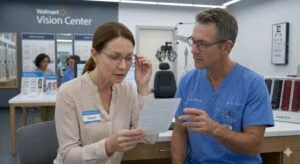
How Quickly Can You Tell Something Is Off?
Most patients notice within the first few days whether new lenses feel comfortable. Mild errors may take longer to surface — particularly with progressive lenses, where the adjustment period is naturally longer. If discomfort continues past two weeks without improvement, that is a clear signal to contact your eye care provider.
How Optometrists Measure Your Prescription
Optometrists use a two-stage process to determine your prescription. The first stage is objective measurement using an autorefractor or retinoscope, which provides a baseline reading of how your eye focuses light. The second stage is subjective refraction — the familiar “which is clearer, one or two?” test — where your responses guide the final prescription values.
Understanding how a comprehensive eye exam works — including every test your optometrist performs to assess your vision and eye health — helps you recognize where the measurement process can go right or wrong.
Both stages are necessary because objective instruments measure the eye's optics, while subjective refraction captures how your brain and visual system actually process what you see. Neither stage alone is sufficient for an accurate prescription.
Where Human Error Can Enter the Process
The subjective refraction stage is where most errors originate. Your responses during the test directly influence the final numbers. Fatigue, distraction, or uncertainty when answering can shift the result. Optometrists are trained to guide patients through this process carefully, but the quality of your responses matters.
Additional error points include:
- Instrument calibration issues with the autorefractor
- Incorrect pupillary distance (PD) measurement, which affects lens alignment
- Transposing numbers when recording sphere, cylinder, or axis values
- Errors when transferring the prescription to the lab order
Most Common Prescription Errors and Their Causes
Prescription errors fall into two broad categories: measurement errors that occur during the exam and administrative errors that occur after it.
Knowing what to expect at your eye exam before you arrive helps you participate more accurately in refraction testing, which directly reduces the chance of a measurement error.
Errors in Refraction Testing
Refraction errors are the most clinically significant type. They include:
- Sphere power errors: The lens is too strong or too weak, causing blur at specific distances.
- Cylinder and axis errors: These affect astigmatism correction. An incorrect axis value — even by a few degrees — can cause distortion and eye strain.
- Add power errors: In bifocal or progressive prescriptions, an incorrect near-vision add power makes reading difficult or uncomfortable.
Patient-related factors also contribute. Patients who are tired, anxious, or unsure how to respond during refraction testing may give inconsistent answers, making it harder for the optometrist to land on the most accurate values.
Communication and Transcription Mistakes
Even when the exam itself is accurate, errors can occur afterward. Transcription mistakes — writing the wrong number, transposing OD and OS (right and left eye), or entering an incorrect axis — can result in lenses that do not match the intended prescription. Lab fabrication errors, though less common, can also produce lenses that deviate from the written order.
This is why reviewing your written prescription before leaving the office is a practical habit. Confirm that your name, the date, and all values look consistent with what your optometrist discussed with you.
What to Do If You Think Your Prescription Is Wrong
If your new glasses or contacts do not feel right, do not wait and hope the discomfort resolves. Take these steps:
- Give it two weeks. A short adjustment period is normal, especially with a significant prescription change or new progressive lenses. Track your symptoms and note whether they improve, stay the same, or worsen.
- Document your symptoms. Write down what you experience — when it happens, which distances are affected, and whether it is worse in one eye. This information helps your optometrist identify the source of the problem quickly.
- Contact your eye care provider. Call the office and describe your symptoms. Most practices will schedule a recheck at no additional charge within a reasonable window after your exam.
- Bring your previous glasses. Comparing your old and new lenses helps the optometrist assess whether the prescription change is the source of the problem.
If your vision feels off after receiving new glasses or contacts, the most direct step is to schedule an eye exam at Arizona's Vision Eye Care Center so your optometrist can recheck your prescription and correct any error quickly.
How to Request a Prescription Recheck
Ask specifically for a prescription recheck — not just a general follow-up. Explain that you are experiencing symptoms consistent with an incorrect prescription and that you would like the refraction repeated. A reputable optometrist will take this request seriously and work with you to resolve the issue.
When to See an Ophthalmologist Instead
Most prescription errors are straightforward to correct with a recheck. However, some symptoms that feel like a wrong prescription are actually signs of an underlying eye condition that requires medical evaluation.
Understanding the difference between an optometrist vs. ophthalmologist helps you know exactly when a prescription concern requires routine rechecking versus a referral for a more complex medical eye condition.
Seek evaluation beyond a standard recheck if you experience:
- Sudden vision loss or a significant change in vision in one eye
- Flashes of light, floaters, or a curtain-like shadow in your visual field
- Eye pain, redness, or sensitivity to light alongside vision changes
- Double vision that is new or worsening
These symptoms may indicate conditions such as retinal detachment, glaucoma, or other medical issues that fall outside the scope of a routine prescription correction. An optometrist can identify these concerns and refer you to an ophthalmologist when needed.
Arizona's Vision Eye Care Center offers a full range of eye care services — from routine prescription rechecks to coordinated referrals — so patients always receive the right level of care for their specific vision needs.
Conclusion
Prescription errors are a real and correctable part of eye care. Understanding how they happen — through refraction testing, transcription, or lab fabrication — gives you the knowledge to recognize symptoms early and respond effectively.
Most errors are resolved quickly with a recheck, and your optometrist is your first and best resource when something feels off. Timely communication leads to faster correction.
At Arizona's Vision Eye Care Center, our team is committed to getting your prescription right and making sure you see clearly and comfortably — contact us to schedule a recheck or your next comprehensive exam.
Frequently Asked Questions
Can an optometrist give you the wrong prescription by mistake?
Yes. Prescription errors can result from measurement inaccuracies during refraction testing, transcription mistakes, or lab fabrication issues. Most errors are minor and correctable with a recheck appointment.
How do I know if my glasses prescription is wrong?
Persistent blurry vision, headaches, eye strain, or dizziness after two or more weeks with new lenses are the most common signs. If symptoms do not improve after a normal adjustment period, contact your optometrist.
What should I do if my new glasses don't feel right?
Give yourself one to two weeks to adjust, document your symptoms, and then contact your eye care provider to request a prescription recheck. Bring your previous glasses to the appointment for comparison.
Can a wrong prescription damage your eyes?
Wearing an incorrect prescription will not permanently damage your eyes, but it can cause significant discomfort, eye strain, and headaches. Correcting the prescription resolves these symptoms.
How common are prescription errors from optometrists?
Prescription errors occur but are not the norm. Studies on refractive error variability suggest that small measurement differences are inherent to the subjective refraction process. Most discrepancies are within a clinically acceptable range and can be refined with a follow-up exam.
Can I get a free recheck if my prescription is wrong?
Most optometry practices offer a complimentary recheck within a set period — typically 30 to 90 days — after your original exam. Ask your provider about their specific policy when you call to report your symptoms.
Should I see an ophthalmologist if my prescription feels wrong?
In most cases, start with your optometrist for a recheck. If your symptoms include sudden vision loss, flashes, floaters, eye pain, or double vision, seek evaluation from an ophthalmologist, as these may indicate a medical eye condition rather than a simple prescription error.

Dr. Page is a licensed Doctor of Optometry, and a long time resident of Ahwatukee Arizona. He graduated from the New England College of Optometry in Boston in 1990. He moved to Phoenix to serve the community in both his clinic and by becoming a community activist.
He is deeply involved in supporting the local athletic teams, the arts, pet adoption and children. He is a charter member of the Chamber of Commerce.
After watching his father lose vision in his right eye he dedicated his career to finding a way to stopping eyes from getting worse. He is the founder of the Invisalens eye retainer and a best selling author for his book: Freedom! The Smart Parents Guide to Helping Your Child See a Better Life.
He specializes in helping his patients see better with eyeglasses, contact lenses, nutrition and genetics.
Words can't describe what our eyes bring to life!