Arizona's Vision Eye Care Center

Prescription glasses are marked up anywhere from 100% to over 1,000% above their wholesale cost, depending on where you buy them, which brand you choose, and what lens options you add. That range is not a typo. It reflects one of the most variable pricing structures in consumer healthcare, and understanding it helps you make smarter decisions about your vision care spending.
Most patients are surprised to learn that the frames sitting in a retail display case may have cost the retailer as little as $10 to $30 wholesale, yet sell for $150 to $400 or more. Lenses follow a similar pattern. The gap between production cost and retail price is wide across the industry, but the reasons behind it are more nuanced than simple profit-taking.
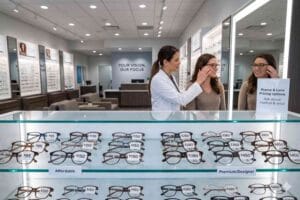
How Much Do Retailers Mark Up Prescription Glasses?
The average markup on prescription glasses at traditional optical retailers falls between 200% and 500% above wholesale cost. Some designer frames from luxury brands carry markups exceeding 1,000%. Lenses, particularly premium progressive or anti-reflective coated options, are often marked up 300% to 800% above their manufacturing cost. The combined retail price for frames and lenses at a mid-range optical chain typically lands between $200 and $600 before insurance.
Why the Markup Range Is So Wide
Several factors explain why markup varies so dramatically across the industry. Retail overhead is a primary driver. Optical shops inside shopping malls or medical office buildings carry significant rent, staffing, and inventory costs that get built into frame and lens pricing. Brand licensing is another major factor. Luxury eyewear brands like Luxottica-owned labels command premium prices partly because of licensing fees embedded in the wholesale cost before the retailer adds their own margin. Finally, the lack of price transparency in optical retail means most consumers have no reference point for what glasses “should” cost, which allows wide markup ranges to persist without significant market pressure.
What Drives the Cost of Frames vs. Lenses
Frames and lenses are priced through entirely separate supply chains. Frames are largely a fashion and branding product. The physical materials, whether acetate, titanium, or stainless steel, rarely justify the retail price on their own. Lenses, by contrast, carry markup tied to optical technology. High-index lenses, progressive designs, and specialty coatings like blue light filtering or photochromic treatments involve genuine manufacturing complexity. However, even accounting for that complexity, lens markups at traditional retailers remain substantially higher than what independent labs or online suppliers charge for comparable products.
Knowing what markup is built into your glasses purchase is only part of the picture. Understanding your eyeglass prescription gives you the clinical foundation to compare options across retailers, ask the right questions, and avoid paying for lens upgrades you may not actually need.
Where You Buy Glasses Determines What You Pay
Retail channel is the single biggest variable in what you pay for prescription glasses. The same prescription filled at three different locations can produce price differences of several hundred dollars.
Starting with a comprehensive eye exam from a licensed optometrist ensures your prescription is accurate and current before you invest in new lenses, regardless of where you ultimately purchase your frames.
Independent Optometrists vs. Big-Box Retailers vs. Online
Independent optometry practices typically offer mid-range markups with a higher emphasis on personalized fitting, lens quality verification, and follow-up adjustments. Big-box retailers like Costco Optical are widely recognized for lower markups, often in the 100% to 200% range, due to their high-volume purchasing power. Online retailers offer the lowest sticker prices but require patients to have an accurate pupillary distance measurement and accept that fitting adjustments are not available after purchase. Each channel involves trade-offs between price, service, and clinical oversight that patients should weigh based on their prescription complexity and personal preferences.
How to Evaluate Whether You're Getting Fair Value
Fair value in prescription eyewear is not simply the lowest price. It accounts for lens accuracy, frame fit, durability, and the availability of adjustments or remakes if something is wrong. A few practical benchmarks help patients assess whether a quoted price is reasonable.
Ask for an itemized breakdown of frame cost versus lens cost. Reputable optical providers will provide this without hesitation. Compare the lens package price against what independent online labs charge for the same lens type and coating. If the difference exceeds $150 to $200 for a standard prescription, you are likely absorbing a significant retail markup without a corresponding service benefit. Patients with complex prescriptions, including high myopia, astigmatism, or progressive needs, often benefit from purchasing lenses through a provider who can verify optical accuracy in person rather than relying solely on online fulfillment.
Vision insurance coverage can meaningfully offset retail markup, but only when patients understand what their plan actually covers for frames, lenses, and lens enhancements before they sit down at the optical counter.
Conclusion
Prescription glasses carry markups that range from modest to extraordinary, shaped by retail channel, brand positioning, lens technology, and overhead costs built into every price tag.
Patients who understand how markup works are better positioned to compare options, ask informed questions, and choose eyewear that delivers genuine optical value rather than brand premium alone.
At Arizona's Vision Eye Care Center, we help patients navigate every step of the vision care process with clarity and confidence. Schedule your eye exam with us today.
Frequently Asked Questions
Is it cheaper to buy glasses online than at an eye doctor's office?
Online retailers typically offer lower prices due to reduced overhead, but they cannot verify lens accuracy or provide in-person fitting adjustments. Complex prescriptions carry higher risk when purchased without clinical oversight.
Why do prescription glasses cost so much more than the frames alone?
Lenses are priced separately and often carry higher markups than frames. Specialty coatings, progressive designs, and high-index materials each add cost, and retail markup is applied to the combined package.
Do vision insurance plans reduce the markup on glasses?
Vision insurance provides allowances for frames and lenses that offset retail markup, but coverage limits vary significantly by plan. Patients should review their benefits before selecting frames or lens upgrades.
What is a fair price to pay for prescription glasses?
A reasonable benchmark for a complete pair of single-vision glasses with standard coatings is $150 to $300 at a mid-range retailer. Progressive lenses with premium coatings typically range from $300 to $600 depending on the provider.
Can I use my prescription from one provider to buy glasses elsewhere?
Yes. Patients have the legal right to receive a copy of their eyeglass prescription after an exam and use it at any optical retailer or online supplier of their choosing.

Dr. Page is a licensed Doctor of Optometry, and a long time resident of Ahwatukee Arizona. He graduated from the New England College of Optometry in Boston in 1990. He moved to Phoenix to serve the community in both his clinic and by becoming a community activist.
He is deeply involved in supporting the local athletic teams, the arts, pet adoption and children. He is a charter member of the Chamber of Commerce.
After watching his father lose vision in his right eye he dedicated his career to finding a way to stopping eyes from getting worse. He is the founder of the Invisalens eye retainer and a best selling author for his book: Freedom! The Smart Parents Guide to Helping Your Child See a Better Life.
He specializes in helping his patients see better with eyeglasses, contact lenses, nutrition and genetics.
Words can't describe what our eyes bring to life!