Arizona's Vision Eye Care Center

The best eye doctor for most people is an optometrist — a licensed primary eye care provider who handles routine exams, vision correction, and many common eye conditions. When a condition requires surgery or advanced medical treatment, an ophthalmologist becomes the right choice. The title that fits you best depends entirely on what your eyes need right now.
Understanding this distinction removes a lot of confusion. Both are real doctors. Both are trained to protect your vision. But they serve different roles in your care, and knowing which one to see first saves you time, reduces unnecessary referrals, and gets you the right help faster.
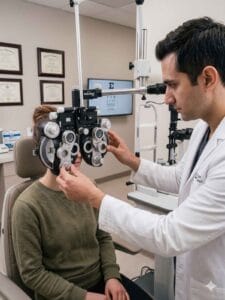
The Two Main Types of Eye Doctors and What They Do
There is no single “best” eye doctor title that applies to everyone. There are two distinct types of eye care professionals, each with a defined scope of practice, and the right one for you depends on your specific situation.
An optometrist holds a Doctor of Optometry (OD) degree and completes four years of optometry school following undergraduate education. An ophthalmologist holds a medical degree (MD or DO), completes medical school, and then finishes a residency in ophthalmology — often followed by a subspecialty fellowship. Both are trained to examine eyes and diagnose conditions. The difference lies in what they can do next.
What an Optometrist Does
An optometrist is your primary eye care provider. They perform comprehensive vision and eye health exams, prescribe glasses and contact lenses, screen for conditions like glaucoma and macular degeneration, and diagnose and manage many eye diseases. In Arizona, optometrists are licensed to prescribe a range of medications to treat eye conditions, including infections, dry eye, and inflammation. For most patients — children, adults, and seniors — an optometrist is the right starting point and, in many cases, the only eye doctor they will ever need.
What an Ophthalmologist Does
An ophthalmologist is a medical doctor who specializes in eye and vision care at the surgical and complex medical level. They perform procedures such as cataract surgery, LASIK, retinal surgery, and treatment for conditions like diabetic retinopathy or advanced glaucoma. Ophthalmologists also manage serious eye injuries and diseases that require interventions beyond the scope of optometry. Most patients reach an ophthalmologist through a referral from their optometrist, who identifies a condition that requires that higher level of care.
A comprehensive eye exam with an optometrist is typically where that care pathway begins — and where most patients find that their vision needs are fully addressed without needing to go further.
How to Know Which Eye Doctor You Need
For the majority of patients in Phoenix, the answer is straightforward: start with an optometrist. If you need a glasses or contact lens prescription, are due for a routine eye health screening, are experiencing mild eye discomfort, or want to monitor a known condition like dry eye or early glaucoma, an optometrist provides complete, appropriate care.
The decision becomes more nuanced when symptoms suggest something more serious. Sudden vision loss, flashes of light, a significant increase in floaters, eye pain that does not resolve, or a diagnosis that requires surgical intervention — these are signals that ophthalmology involvement is warranted. Recognizing common eye conditions early, through regular optometry visits, is often what makes the difference between a straightforward treatment and a more complex one.
When a Referral From Your Optometrist Makes Sense
A referral is not a sign that something has gone wrong. It is a sign that your optometrist is paying close attention. When an exam reveals a condition that requires surgical evaluation, imaging beyond what is available in an optometry office, or a second opinion from a subspecialist, your optometrist will coordinate that referral directly. In most cases, you will continue seeing your optometrist for ongoing monitoring even after an ophthalmologist has managed the acute issue. The two work together, not in competition.
What “Best” Really Means in Eye Care
The word “best” in this context does not mean most qualified in an absolute sense. It means most appropriate for your current need. An ophthalmologist is not a better eye doctor than an optometrist — they are a different kind of eye doctor serving a different clinical purpose. Seeing a surgeon for a routine eye exam is no more appropriate than seeing a primary care physician for a procedure that requires a specialist. The best eye doctor is the one whose training and scope of practice match what your eyes actually need at this moment in your care.
Conclusion
The best eye doctor is the one who matches your specific vision and eye health needs. For most patients, that is an optometrist — trained, licensed, and equipped to provide complete primary eye care.
When conditions require surgical expertise or advanced medical management, an ophthalmologist steps in, often guided by a referral from your optometrist. For parents and caregivers, understanding this pathway early — including when to schedule children's eye exams — helps ensure the whole family receives timely, appropriate care.
At Arizona's Vision Eye Care Center, we help patients in Phoenix navigate these decisions with clarity and confidence. Schedule your exam today and let us guide you to the right care.
Frequently Asked Questions
Is an optometrist or ophthalmologist better for routine eye exams?
An optometrist is the appropriate provider for routine eye exams. They are trained specifically in primary eye care, vision testing, and preventive eye health screening for patients of all ages.
Can an optometrist treat eye disease?
Yes. Optometrists diagnose and manage many eye diseases, including dry eye, glaucoma, diabetic eye disease, and eye infections. In Arizona, they are licensed to prescribe medications for a range of eye conditions.
What is an optician, and how is that different?
An optician is a trained technician who fits and dispenses eyeglasses and contact lenses based on a prescription written by an optometrist or ophthalmologist. Opticians do not examine eyes or diagnose conditions.
Do I need a referral to see an ophthalmologist?
Not always, but most patients reach an ophthalmologist through a referral from their optometrist. If you have a known condition requiring surgical evaluation, you may contact an ophthalmologist directly.
What kind of eye doctor should children see?
Children should see an optometrist for routine vision and eye health exams. Optometrists are trained to detect amblyopia, strabismus, and refractive errors in pediatric patients and will refer to a pediatric ophthalmologist when needed.
